In Western Australia, researchers are using the Campbell Scientific FluoreSens™10 to study how vegetation responds to hotter, drier climates and to strengthen the connection between field observations and remote sensing.
Monitoring Ecosystem Stress in a Hotter, Drier Climate
In Southwestern Australia, changes in the climate are already part of the measurement record. Annual rainfall has declined since the 1970s, with that decline accelerating since the early 2000s. For ecosystems adapted to an already dry climate, understanding how plants respond to these changes is becoming increasingly important.
Dr. Caitlin Moore and her colleagues at the University of Western Australia (UWA) are looking for signals that can reveal those responses sooner.
Funded by Australia’s Terrestrial Ecosystem Research Network (TERN) and the Western Australia state government, Moore’s project is adding new measurement capabilities to existing ecosystem monitoring sites. One of those capabilities is sun-induced chlorophyll fluorescence (SIF) measured in the field with the Campbell Scientific FluoreSens 10.
What is SIF?
SIF is a faint light—invisible to the human eye—that plants emit while photosynthesizing. Because it tracks photosynthesis directly, it can reveal plant stress before that stress shows up as a visible change in leaf color.
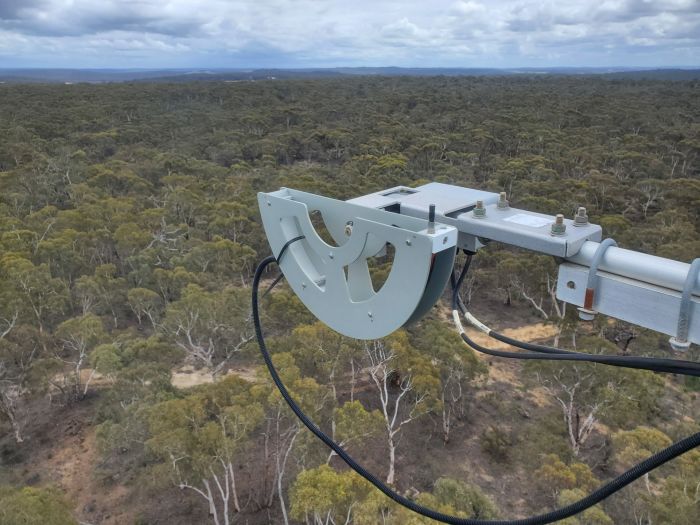
SIF can be measured with the FluoreSens 10.
How SIF Can Detect Plant Stress Before Changes in Greenness
Moore came to SIF research through micrometeorology and eddy-covariance measurements. During a postdoctoral research position in the United States, she was introduced to measuring SIF passively in the field using spectrometers. What caught her attention was the relationship between SIF and photosynthesis.
Many remote-sensing approaches use vegetation greenness as an indicator of plant condition and productivity. Those measurements are valuable, but a visible change in greenness can occur after the physiological response that caused it.
“If we’re using it as a crop or plant-stress detection tool, it’s better to have an early warning from a change in photosynthesis,” Moore said. “By the time you’ve got a change in greenness, there’s not a lot you can do in terms of management.”
SIF offers another perspective. Because the signal is more closely linked with photosynthesis and plant productivity, Moore sees an opportunity to investigate stress closer to the point when a plant’s internal processes, such as photosynthesis, first begin to change, rather than waiting until that stress becomes visible as a change in greenness.
In dry, arid Western Australia, that timing is important. “A lot of our ecosystems are at the forefront of a hotter, drier climate,” Moore said. Testing sensing technologies that are more closely linked with productivity and stress, she explained, is particularly timely in a region where plants are already responding to those conditions.
Monitoring a Eucalyptus Woodland in Western Australia
Moore’s SIF measurements are being collected in a eucalyptus woodland in Western Australia. The woodland is remnant vegetation from an ecosystem that once covered much of the region before substantial areas were cleared for cropping and sheep grazing.
The site already includes an eddy-covariance tower, giving researchers detailed measurements of carbon and water exchange between the ecosystem and the atmosphere. Adding SIF provides another layer of information about how the woodland is functioning.
For Moore, that combination is particularly valuable.
“What the SIF system adds is an additional layer, an additional component of measurements,” she said, helping researchers address remaining questions about how ecosystems respond to their environment.
The project also includes a paired agricultural site at a nearby University of Western Australia farm. Together, the sites contribute to a broader effort to understand the behavior of remnant vegetation and managed agricultural land.
From Prototype to the FluoreSens 10 for Field-Based SIF Measurements
Introducing a relatively new field measurement comes with practical challenges. Moore initially worked with a prototype SIF system while Campbell Scientific was developing the commercial FluoreSens 10. The prototype encountered technical problems in the hot, dry environment. Moore worked with the Campbell Scientific team as the system developed, and the site ultimately transitioned to the FluoreSens 10.
Since September 2024, the system has been running smoothly.
Moore compared beta testing to making the first pancake in a batch: “It can be a bit wobbly when it goes in the pan.”
Some lessons were surprisingly small and practical. The instrument works by collecting light through its fiber-optic cable and measuring a faint signal within that light, the fluorescence that plants naturally give off as a byproduct of photosynthesis. Getting an accurate reading depends on that cable capturing light correctly. At one point, Moore discovered that the cosine corrector, a small light-collecting attachment on the end of the fiber-optic cable, could become loose as the system moved. She needed a way to secure it without permanent attachment to the cable, as this might later need replacement. Her eventual field solution was silicone, which held the component in place but could still be easily removed if necessary.
“Having that kind of improvising ability in the field is really important,” Moore said.
Her other advice is even simpler: bring spares.
Using Ground-Based SIF Measurements to Validate Remote Sensing Data
The value of Moore’s ground measurements extends beyond the area seen by the tower.
SIF can also be measured remotely, mostly using satellite data, creating an opportunity to connect detailed observations at field sites with measurements covering much larger areas. But those large-scale products need reliable observations on the ground for calibration and validation.
Without strong ground-based measurements, she explained, “it makes it hard to validate and trust the remote sensing products.”
How does ground-based SIF data improve remote sensing?
Satellites can cover large landscapes, but those readings need ground-truth data to be validated. Field measurements such as Moore’s give researchers a reliable reference point to calibrate and trust satellite-scale SIF products. Making field data available to the broader research community can help improve those products and the models that use them.
Improving Ecosystem Stress Detection with SIF
Moore sees considerable potential for SIF over the next five to ten years, particularly if more ground-based monitoring sites become available to support the calibration and validation of remote-sensing products.
Current remote-sensing products already provide valuable information about ecosystem condition and productivity, so the goal isn’t to replace existing measurements. SIF could add information that helps researchers recognize changes closer to when they occur, including productivity declines and ecosystem stress events that may precede visible changes in vegetation.
Eventually, Moore sees potential for those measurements to contribute to tools for growers and ecosystem managers, as well as ecological forecasting efforts that combine observations with models to explore how ecosystems may respond to climate variability and changing weather patterns.
Reaching that point requires continued field research across many types of ecosystems. That makes Moore’s woodland site one piece of a much larger effort.
“I’m glad to be one of the sites of many that are coming online around the world,” she said. Those sites can provide ground-based evidence researchers need to determine where SIF works well, how it behaves across ecosystems, and what the signal can ultimately tell us.
The case study photos were provided by Dr. Caitlin Moore.
This work is supported by the use of Terrestrial Ecosystem Research Network (TERN) infrastructure, which is enabled by the Australian Government's National Collaborative Research Infrastructure Strategy (NCRIS), and contributes to environmental journal articles.